Ultimate 11
- 4.8
- Rating
- 10.00K
- Installs
- Free
- Price

 Analysis by App-foxy
Ultimate 11 is a football strategy game from Vaulty Studios Inc. that puts the focus on building a team rather than simply controlling every pass and tackle. I found the appeal easy to understand: you are trying to shape an effective starting lineup, make sensible choices, and work toward winning the trophy. It is free to play, rated for Everyone, and the straightforward “Ultimate 11” idea makes it approachable for someone who wants a compact sports game without learning a complicated control system first.
My first impression was that this is best viewed as a drafting and decision-making experience with a football theme. The important question is not whether it can replace a full football simulator, because it cannot offer the same kind of hands-on match control as a traditional console-style sports game. Instead, it asks whether you can recognize the pieces of a strong squad and turn them into a convincing starting team. That distinction matters before you install it.
What to expect when you begin
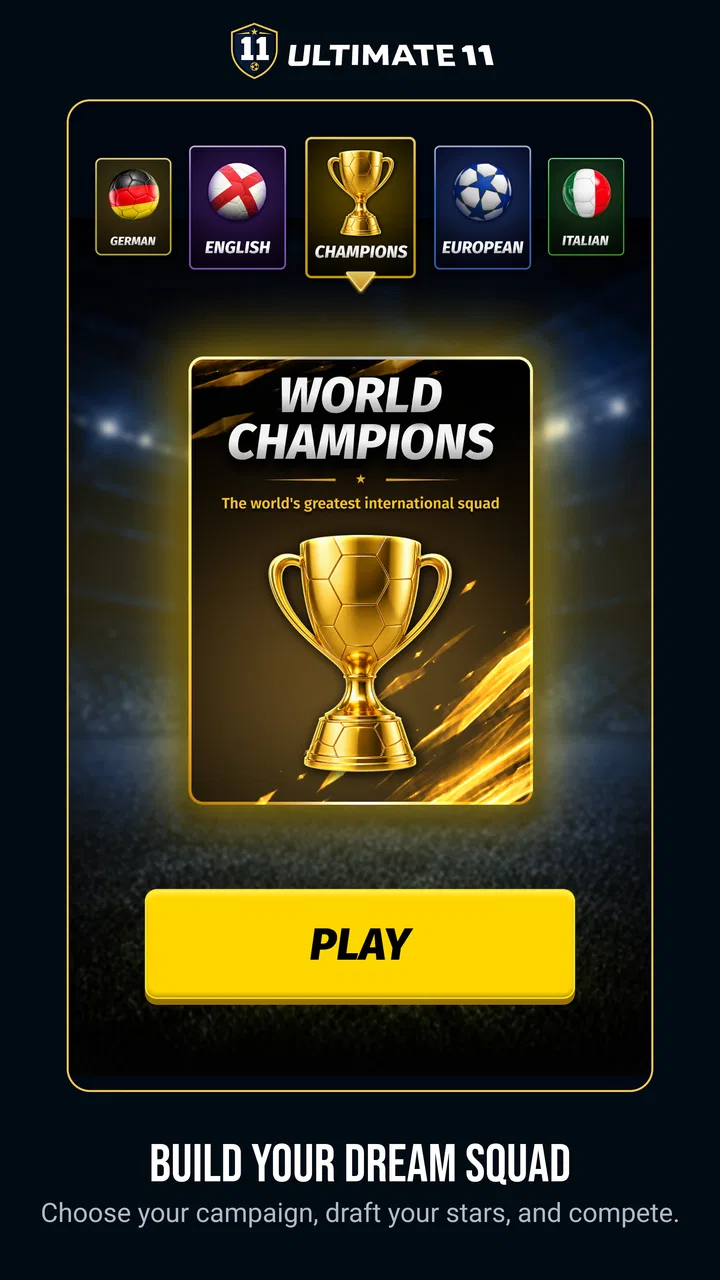
The store summary presents a clear fantasy: draft football legends, assemble an Ultimate XI, and chase the trophy. In practice, I approached each choice as part of a larger team-building puzzle. A famous name can be tempting, but a balanced lineup is usually more useful than collecting impressive individuals without considering how they fit together. That is the central habit I recommend developing early.
You May Also Like

 Blood Strike: 2.5 Anniversary
Blood Strike’s Loadouts Turn Every Drop Into a Tactical Gamble
A close look at Blood Strike’s custom loadouts: how fast access to signature weapons reshapes its battle royale rhythm, rewards preparation, and narrows the gap between fights.

 Pandora - Music & Podcasts
Pandora’s Music Is Easy to Start, but Harder to Recover
Pandora’s strength is its low-effort path from a seed to a station. Its weak spot is how much confidence it asks you to place in connection, setup, and quiet recovery.

 8 Ball Pool
 Is Built on Rivalries, Rematches, and Routine
A close look at the rivalries, rematches, shared routines, and unanswered safety questions that turn a quick pool match into a persistent mobile community.

 Samsung Music
’s Quiet Strength Is Playing What You Already Own
Its reach comes less from spectacle than from dependable access to a personal library. That simplicity is both the app’s strongest retention engine and its ceiling.

 AccuWeather: Weather Radar
AccuWeather Review: A Quick, Clear Forecast for Everyday Decisions
For everyday plans, the best forecast is the one you can understand quickly. AccuWeather makes rain timing, radar, and local conditions easy to act on, with a few trade-offs.

 Hill Climb Racing
Why Hill Climb Racing Still Turns Crashes Into One More Run
A tiny car, a bumpy hill and one more upgrade: Hill Climb Racing keeps resurfacing because its simple chaos makes every near-miss feel personal.
More From Our News Desk
View All News


Because the game belongs to the Sports category, a new player may expect an action-heavy experience. I would set expectations differently. The satisfying moments come from evaluating options, arranging your eleven, and seeing whether your decisions produce a team that feels coherent. If you enjoy football management ideas but do not want a dense spreadsheet-style simulator, this lighter approach is likely to feel more welcoming.
The game has a 4.8 average from around 88 ratings, and it has passed 10 thousand installs. Those figures suggest that the concept has found an interested audience, while the relatively small scale also makes it feel more like a focused title than a huge, established sports platform. I would not choose it because of popularity alone; I would choose it because the draft-and-lineup premise matches the kind of short decision-making sessions I enjoy.
One useful way to think about the opening is to separate three goals. First, learn what each selection is asking you to do. Second, create a lineup that covers the basic needs of a football team. Third, notice which decisions actually affect your progress toward the trophy. Trying to optimize everything immediately can make the first session feel harder than it needs to be.
The game is free, which lowers the barrier to testing it. I still recommend giving yourself a few quiet minutes for the first session rather than opening it while distracted. Drafting choices are easier to judge when you can compare them calmly. A rushed selection may leave you wondering whether the problem was the player, the position, or the overall shape of your team.
Who will enjoy the format
I think Ultimate 11 suits players who like football but prefer planning to reflexes. It can work well for a quick break, a commute, or a short evening session when you want a sports-themed challenge without committing to a long match. It is also a reasonable starting point for someone unfamiliar with football management games, since the basic objective is easy to explain: build a strong eleven and pursue the trophy.
It is less suitable for anyone looking for realistic match physics, detailed player control, or the feeling of personally dribbling through a defense. A conventional football simulator is the better choice if your favorite part of the sport is timing shots, defending manually, or reproducing an entire match. Ultimate 11 is about the decisions before and around competition, not about replacing that experience.
From installation to your first meaningful result
I’ll use this section to make the first session feel manageable: the aim is to understand the draft and build a lineup with a clear purpose, not to master every decision at once. I find it helpful to treat the opening choices as a chance to learn what the team needs, then look more closely at how to make that first lineup feel complete.
Set up your first team without overthinking it
After installing the game, I would begin by reading each prompt carefully and resisting the urge to select the most recognizable option automatically. The first lineup is a learning tool. You are not only trying to create a strong team; you are also learning how the game presents its choices and what kind of balance it seems to reward. Treating the opening draft as an experiment makes mistakes much less frustrating.
My practical advice is to build from the shape of the team outward. Look at the positions that need covering, then consider whether your choices leave obvious gaps. A lineup with several exciting attacking options may still feel weak if it lacks dependable support elsewhere. This is one of the less obvious lessons of the game: a draft is not a popularity contest. It is a puzzle about how individual selections work together.
When I reached a decision between a celebrated player and a less glamorous option, I asked myself which one improved the whole eleven. That question is more reliable than choosing based on reputation alone. It also gives first-time players a simple rule to follow when the interface presents several appealing possibilities at once.
Do not worry about making the perfect opening team. The first meaningful success is not necessarily winning the entire competition immediately. It can be completing a lineup that makes sense, understanding why you chose it, and reaching the next stage with a clearer idea of what to watch for. That small milestone gives you a foundation for better decisions later.
How to recognize a successful first action
A good first action is one that improves the team rather than merely adding a memorable name. I found it helpful to pause after each selection and ask two quick questions: what role does this choice fill, and what does it leave unresolved? This turns the draft into a sequence of manageable decisions instead of one overwhelming attempt to predict the whole outcome.
For a realistic everyday scenario, imagine opening the game during a lunch break. You have enough time to make a few choices but not enough time to study every possibility. In that situation, I would prioritize a complete, sensible lineup over chasing a perfect combination. Make sure the team has coverage across its important areas, note any weakness you can address later, and stop once the next step is clear. This approach keeps the session useful without turning a short break into a research project.
Another helpful habit is to remember why a choice felt right or wrong. If a lineup performs poorly, do not immediately replace everything. Identify the decision that created the biggest imbalance. Perhaps you overfilled one area, ignored a needed role, or selected players individually without considering the eleven. Changing one part at a time teaches you more than starting over blindly.
The game’s simple premise encourages quick play, but quick does not have to mean careless. My strongest early results came from spending a little longer on the structure of the team. That extra thought is the difference between tapping through the draft and actually learning how to play it.
Common confusion during the first sessions
The most likely confusion is assuming that the most famous football legends must always be the correct picks. The title’s theme naturally pushes you toward star power, but building an Ultimate XI requires more than filling the screen with celebrated names. If your team feels unbalanced, the solution may be a less obvious selection that completes the structure rather than another headline player.
A second source of uncertainty is knowing whether a disappointing result means the entire team is wrong. I would avoid that conclusion. A single weak area can affect how the whole lineup feels, and it is more useful to inspect the shape of the team before discarding every decision. This is where the game rewards patience: the draft gives you a chance to reason about the squad, not just react to the latest outcome.
New players may also wonder how aggressively they should pursue the trophy. My answer is to use the first attempt as a baseline. Once you understand what a complete team looks like, later attempts become more informative because you can compare them with something concrete. Without that baseline, every result can feel random, even when your choices are improving.
There is also a difference between a short session and a serious optimization session. If you only want a quick football-themed diversion, accept a good-enough lineup and enjoy the process. If you want to chase the best possible result, slow down, compare the alternatives, and pay attention to the trade-off between a spectacular individual and a missing team need. The game supports both attitudes, but they produce different kinds of satisfaction.
Three decisions that make the game more rewarding
First, draft for balance before prestige. This sounds simple, but it changes the way you read every choice. Instead of asking which player is most exciting, ask which selection gives your eleven a better foundation. That mindset is especially valuable when the available legends make every option look attractive.
Second, use each attempt as a controlled test. Change one major decision, then observe whether the team feels more complete. This workflow prevents you from losing track of what helped. It is a better long-term method than rebuilding the lineup from scratch after every setback, particularly for players who enjoy understanding systems rather than relying on luck.
Third, separate the fun of collecting a memorable squad from the practical goal of winning. Sometimes the team you personally want to create will not be the team most likely to succeed. That trade-off is part of the appeal. If you value football nostalgia, you may accept a less efficient lineup because the names matter to you. If the trophy is your priority, you will need to make colder, more structural choices.
These decisions are not obvious from the short store description, but they are what gave the game more staying power for me. The draft becomes interesting when the player stops treating it as a list of famous footballers and starts treating it as a team-building problem.
How it compares with familiar alternatives
Compared with a full football simulator, Ultimate 11 is lighter and less demanding. You are not learning a large control scheme or managing every moment of a match. That makes it easier to pick up, but it also means the experience will feel limited if you want direct control and realistic on-field action.
Compared with a deep football manager, it is more immediately approachable. A traditional management game may offer extensive tactics, transfers, training, finances, and long-term planning. Ultimate 11 concentrates on the excitement of assembling a starting eleven and pursuing a trophy. The trade-off is clear: less administrative depth in exchange for a quicker route to the central decision.
Compared with casual sports games built around instant tapping, this title asks for more thought. The choices have a team-building context, so the best session is not always the fastest one. I would recommend it over a purely reflex-based alternative when you want to feel responsible for the shape of your squad. I would recommend the alternative when you want immediate action with almost no planning.
That positioning makes the game particularly useful for players who sit between two audiences: people who love football strategy but do not want a demanding management simulation, and casual players who want something more meaningful than repeated button presses. It will not satisfy everyone, but its narrower focus is also its identity.
Version, audience, and practical fit
The current version is 1.8.0, and the game supports devices running Android 7.0 or later. That makes checking your device’s system version a sensible first step before installing, especially if you are using an older phone or tablet. The age rating is Everyone, so it is designed for a broad audience rather than a mature-only group.
Vaulty Studios Inc. keeps the concept focused on the football draft fantasy instead of presenting it as a broad collection of sports modes. I appreciate that focus because it makes the game easier to understand, although players seeking a large menu of unrelated activities may find the experience narrower than expected.
For families, the Everyone rating makes the game easier to consider as a general football title. I would still encourage younger players to treat the draft as a learning exercise rather than a test they must win immediately. The most useful skill here is comparing options and understanding trade-offs, not simply tapping the fastest.
When I would recommend it—and when I would skip it
I would recommend Ultimate 11 to a friend who enjoys football legends, lineup building, and short strategy sessions. It is a good fit when you want a free game that can be understood quickly but still gives you reasons to reconsider your choices. The strongest audience is someone who enjoys asking, “What does this team need next?”
I would skip it if my main goal were a realistic match simulation. I would also look elsewhere if I wanted a long career mode with detailed club administration or if I disliked replaying decisions to improve a result. The game’s satisfaction comes from refining your approach, so a player who wants a single straightforward playthrough may not get as much from it.
There is a further trade-off for football fans who have a favorite lineup in mind. The game is more interesting when you allow its draft decisions to challenge your preferences. If you insist on using only the players you already like, you may miss the strategic side of the experience. On the other hand, if personal football memories are the main reason you play, that freedom can still be part of the fun even when it is not the most efficient route to the trophy.
The next step after your first trophy attempt
Once you have completed your first meaningful run, I suggest reviewing the team as a whole rather than focusing only on the final result. Which selection made the lineup feel stable? Which area remained difficult to cover? Did you choose a legend because the team needed that role, or because the name was appealing? Answering those questions gives your next attempt a clear purpose.
A useful progression is to set one objective for each new run. You might try to create a more balanced eleven, test a different approach to the draft, or avoid repeating the choice that caused the biggest weakness. This keeps the game from becoming a sequence of identical attempts. It also makes improvement feel earned because you can connect a better result to a specific change.
If you are playing casually, there is no need to treat every session as optimization. Build a team that makes you smile, chase the trophy when you feel like it, and stop before the decisions become tiring. If you are more competitive, take notes mentally and make deliberate changes. The same simple framework supports both relaxed and focused play, provided you understand what you want from the session.
After spending time with it, I see Ultimate 11 as a compact football drafting game with a clear audience and a useful learning curve. It does not try to be a complete football universe. Instead, it gives you a focused challenge: recognize what a team needs, make choices under pressure, and turn a collection of legends into an eleven that can compete. The best reason to try it is the small but satisfying shift from collecting stars to building a team.
For a free sports game with an Everyone rating, that focus makes it easy to recommend as a low-risk trial. Start slowly, build for balance, and judge your first attempt as practice rather than a verdict. If that style of decision-making appeals to you, the pursuit of the trophy can become surprisingly engaging. If you need direct match control or deep club management, choose a more specialized alternative instead.
FAQs for Ultimate 11
01What is Ultimate 11, and what can I do in the app?
Ultimate 11 is a football-themed game focused on building and managing your own dream team. You can usually select players, arrange formations, improve squad performance, and compete in matches or challenges. The main appeal is combining team management with competitive gameplay, although the exact modes, available clubs, and progression features may vary depending on the version installed and future updates.
02Is Ultimate 11 free to download and play?
Ultimate 11 can generally be downloaded without an upfront purchase, but users should check the store listing for the current pricing information before installing it. Free access may be supported by advertisements, optional in-app purchases, or both. Some upgrades, virtual currency, player packs, or time-saving features may require real money, so reviewing purchase settings is recommended, especially when children use the device.
03Does Ultimate 11 require an internet connection?
An internet connection may be needed for important features such as downloading game data, synchronizing progress, receiving updates, viewing advertisements, participating in online competitions, or connecting to a player account. Certain menus or limited gameplay elements might work offline, but you should not assume that the complete experience is available without internet access. Availability can also depend on the game version and device.
04Is Ultimate 11 suitable for beginners?
Ultimate 11 can be approachable for newcomers because team-building games commonly provide tutorials, guided menus, and recommended formations. However, players may still need time to understand tactics, squad upgrades, currencies, and match objectives. Beginners should start with the introductory challenges, avoid spending resources too quickly, and experiment with different lineups before committing to expensive upgrades or competitive modes.
05What should I check before downloading Ultimate 11?
Before downloading Ultimate 11, check whether your Android or iOS device meets the required operating-system version and has enough free storage for the installation and later updates. Also review the game's age rating, privacy information, permissions, advertising policy, and in-app purchase details. If online play is important to you, confirm that the current version supports the required connection and features in your region.
Pros
- Simple controls make matches easy to pick up on mobile.
- Quick match sessions suit short gaming breaks.
- Team-building options add variety beyond individual matches.
- Runs smoothly on many modern Android and iOS devices.
- Offline play is useful when you have limited internet access.
Cons
- Limited tactical depth may disappoint experienced football fans.
- Progress can feel repetitive after several matches.
- Some features may require in-app purchases to unlock fully.
- Match outcomes can sometimes feel influenced by random events.
- Ads may interrupt the experience
- depending on the version.

Ultimate 11
Gallery